Pages

Friday, November 03, 2006

outdoor theater


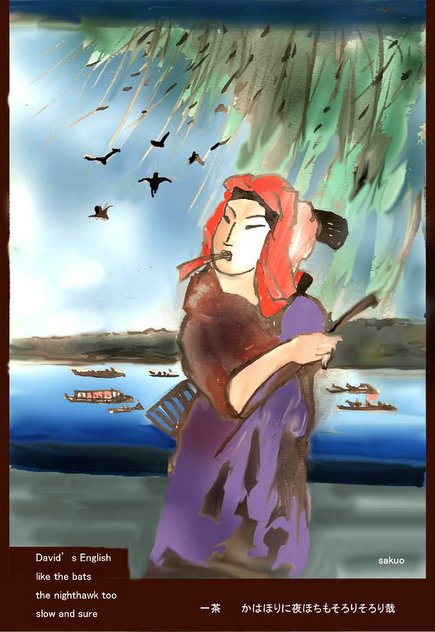
David’s English
like the bats
the nighthawk too
slow and sure

一茶
かはほりに夜ほちもそろりそろり哉
kawahori ni yahochi mo sorori-sorori kana
1824 age 62.

sakuo renku

野外劇場夜の幕開け
yagai-gekijyo yoru no maku ake

outdoor theater
opening the curtain in night

visit
http://cat.xula.edu/issa/ Posted by Picasa

Tuesday, October 31, 2006

leave the nest

David’s English
what day then?
all the hut's sparrows
leave the nest

一茶
幾日やら庵の雀も皆巣立つ
ikka yara io no suzume mo mina su ta[tsu]

by Issa, 1810

sakuo renku
残りたる者年を数える
nokori taru mono toshi wo kazoeru

remaining person
counts his age


visit http://cat.xula.edu/issa/ Posted by Picasa

Sunday, October 29, 2006

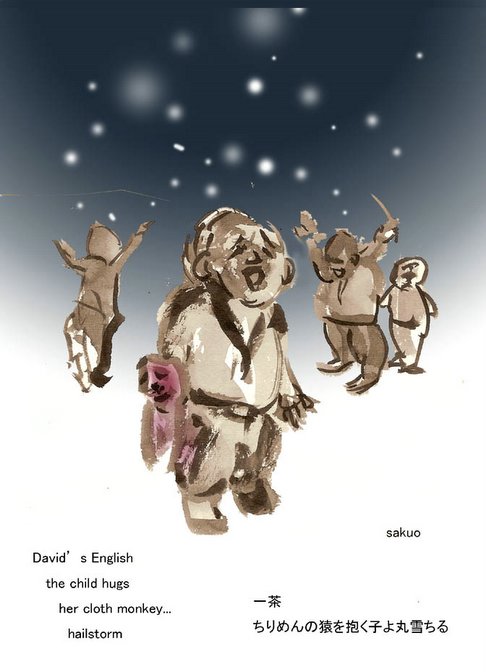
Mama's memento


David’s English and Comment
the child hugs
her cloth monkey...
hailstorm

Or: "his cloth monkey." Specifically, the doll is made of crepe (chirimen).

一茶
ちりめんの猿を抱く子よ丸雪ちる
chirimen no saru wo daku ko yo arare chiru

1813, Age 51 Second Month, he is living in Kashiwabara in a rented house. In autumn, his inheritance dispute finally settled, he moves into his family home.

sakuo Comment and Renku
Issa remembered his boyhood. He was motherless child, being teased. At this time he stayed in home village. There were nobodies who showed their sympathy for him on inheritance dispute.

苛められても形見放さず
izime rare te mo katami hanasa zu

even being teased
not let mama’s memento off


visit http://cat.xula.edu/issa/ Posted by Picasa

Friday, October 27, 2006

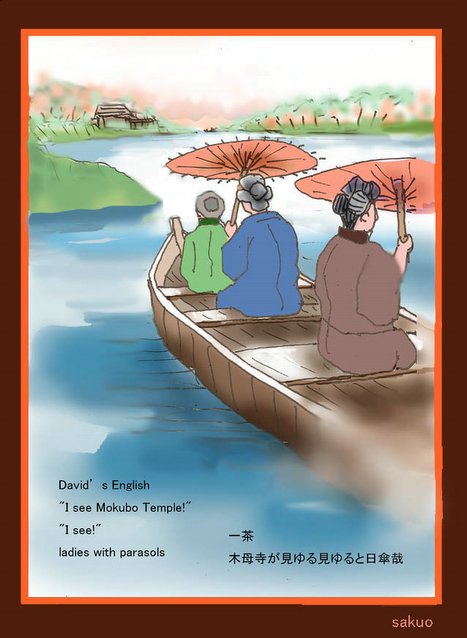
visiting by ship

David’s English
"I see Mokubo Temple!"
"I see!"
ladies with parasols

一茶
木母寺が見ゆる見ゆると日傘哉
mokuboji ga miyuru miyuru to higasa kana

1803, Age 42 staying in Edo. His father die before three years.
Mokubo Temple was famous in Edo.
It’s festival held in spring and is big event.

sakuo Renku
川辺のお寺舟でお参り
kawa-be no otera fune de omairi

The temple near the River
visiting by ship


David’s comment
Issa doesn't directly mention "ladies" in his original text, but Shinji Ogawa suggests that the closing image, higasa ("parasol"), is meant to evoke "ladies with parasols."

visit http://cat.xula.edu/issa/ Posted by Picasa

Thursday, October 26, 2006

even over fifty


David’s English
do not think me
a poor-spirited soul...
mankind's spring

一茶
ふがいない身となおぼしそ人は春
fugainai mi to na oboshiso hito wa haru


1813, Age 51
Second Month, he is living in Kashiwabara in a rented house. In autumn, his inheritance dispute finally settled, he moves into his family home.

sakuo Renku
五十過ぎても我が家持てず
gozyuu sugite mo waga ie mote zu

even over fifty
couldn’t have my house


David’s comment
Issa seems to imply that, unlike other people, he isn't celebrating spring with all of the proper, expected rituals. )儀式, If this is so, the third phrase, hito wa haru ("mankind's spring"), is ironic. Shinji Ogawa helped my translation by untangling Issa's syntax: na oboshi so = "do not think"; hito wa haru = "spring is the prime season for man, or man is in his prime in spring."
visit http://cat.xula.edu/issa/ Posted by Picasa

Tuesday, October 24, 2006

black robe

David’s English
he rolls thin snow
into a Buddha...
the child

一茶
うす雪の仏を作る子ども哉
usu yuki no hotoke wo tsukuru kodomo kana
1813, Age 51

sakuo renku
墨染めの衣まといし仏かな
sumizome no koromo matoishi hotoke kana

wearing black robe
it’s Buddha

http://cat.xula.edu/issa/ Posted by Picasa

Monday, October 23, 2006

whose funeral

David’s English
the year's first sky's
first blemish...
smoke

一茶
はつ空にはやきず付るけぶり哉
hatsu-zora ni haya kizu tsukeru keburi kana

1817 age 55
last year first son born and died after one mounth.

sakuo Renku
誰の葬儀や涙の正月
dare no sougi ya namida no syougatu

Whose funeral
with tears Happy New Year


visit http://cat.xula.edu/issa/ Posted by Picasa

Sunday, October 15, 2006

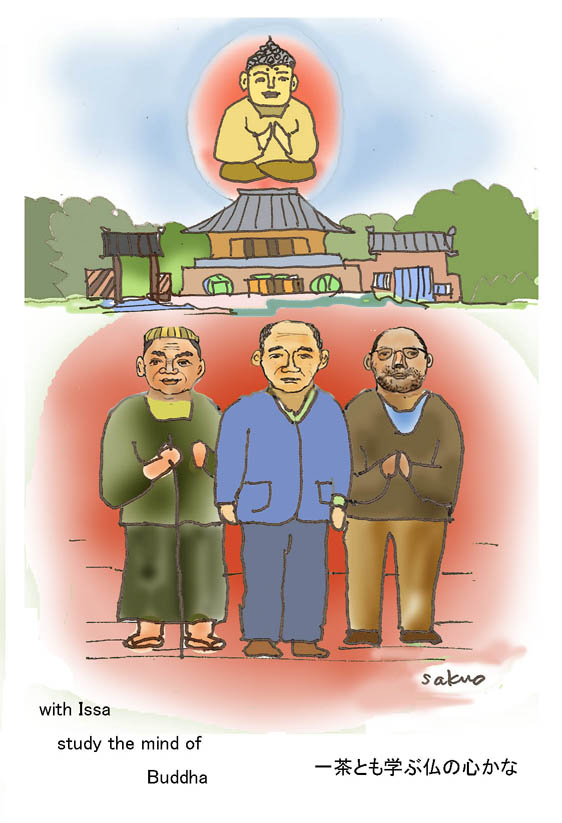
with Issa, Buddhist seminar


sakuo Haiku
一茶とも学ぶ仏の秋日和
issa tomo manabu hotoke no akibiyori

with Issa
study Buddha
autumn day

From 2006/10/16 to 2006/10/23,
I am going to my native town that is in Kanbara-cho, Shizuoka city.
for attending to the Buddhist seminar.
The Temple is in the town, named Kouren-ji and belongs to Pure land sect that is the same of Issa’s .

I have studied Tr. David’s book that is titled as Pure land Haiku .
I have learned high piety of Issa in this book.
I wish to learn the mind of Buddha with Issa and Tr. David at this seminar.

Blog will be off
.2006/10/16—2006/10/23

Friday, October 13, 2006

great Edo


David’s English
great Edo
from nook to nook
"Cuckoo!"

o^edo no sumi kara sumi made hototogisu
一茶
大江戸の隅からすみ迄時鳥

by Issa, 1825
Age 63 divorced with second wife. all his family died.
lonely old daddy wasn’t he?
But he said I still have Haiku.
He wish to state that to all men I am here,
keeping to sing haiku song.

Sakuo Renku
歌うや俳句身内無しでも
utau ya haiku miuti nasi demo

wish to sing haiku
even having no family

visit http://cat.xula.edu/issa/

Wednesday, October 11, 2006

parent and child


David’s English
parents and child
three in a row...
the geese depart

一茶
親と子の三人連や帰る雁
oya to ko no sannin-zure ya kaeru kari

1820 age 58.
Issa lost his dearest daughter in last june.

sakuo Renku
我も子ずれで歩きたや
ware mo ko zure de aruki ta ya

me too with child
wish to walk

Sunday, October 08, 2006

let’s go dance of the festival


David’s English
the yellow gang
the white gang...
butterflies come out

一茶
黄色組しろぐみてふの出立哉
ki[iro]-gumi shiro-gumi cho^ no detachi kana

1820、Age 58.
Last year his first daughter Sato died. Tenth Month his second son is born.

sakuo Renku
神社で始まる祭りの踊りへ
jinjya de hajimaru mature no odori he

let’s go dance of the festival
held at the shrine

Saturday, October 07, 2006

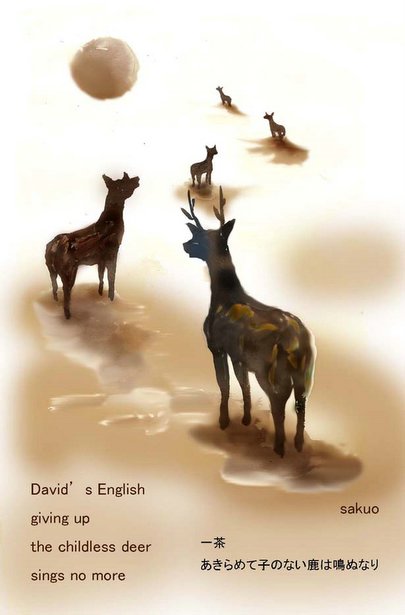
the childless deer

David’s English
giving up
the childless deer
sings no more

一茶
あきらめて子のない鹿は鳴ぬなり
akiramete ko no nai shika wa nakinu nari

by Issa, 1821

David’s comment
In other words, the deer doesn't bother with a mating call. This haiku, composed in the Ninth Month of 1821, seems to refer to Issa's own frustration as a would-be parent. His first three children by this point in time had all died.

sakuo Renku
亡き子を想う恋も忘れて
naki ko wo omou koi mo wasure te

remember the children passed away
forgetting love
 Posted by Picasa

Friday, October 06, 2006

work hard at night

David’s English
at my gate
New Year's starts
at noon

一茶
我門は昼過からが元日ぞ
waga kado wa hiru sugi kara ga ganjitsu zo

1817 age 55, married before three years.

sakuo Rennku
大晦日にも夜なべに励む
oumisoka nimo yonabe ni hagemu

even on New Year's Eve
work hard at night
 Posted by Picasa

Thursday, October 05, 2006

Cool work!

David’s English
my hut's well--
I do its summer cleaning
by hand

一茶
庵の井は手でかへほして仕廻けり
io no i wa te de kaehoshite shimai keri

1816 Age 54, lived in Kashihabara.

sakuo Renku
暑い盛りの涼しい仕事
atui sakari no suzushii shigoto

Cool work
of the hot peak
 Posted by Picasa

Wednesday, October 04, 2006

child and snowman

David’s English
first snow--
making a Buddha of you
is hard too

一茶
はつ雪や仏にするもむづかしき
hatsu yuki ya hotoke ni suru mo muzukashiki

1813 age 51, settled in his native village.
In Autumn, dispute on inheritance has been resolved.

sakuo Renku
降れ降れ雪や子と雪だるま
fure fure yuki ya ko to yuki-daruma

come down down snow
child and snowman
 Posted by Picasa

Monday, October 02, 2006

pale silhouette of plum blossoms

1803
一茶
梅の月花の表は下水也
ume no tsuki hana no omote wa gesui nari

David’s Engalish
plum moon--
facing the blossoms
sewer water

1803, age 41, lived in Edo near Sumida river.

sakuo Renku
脚下の月や梅の薄影
kyatsuka no tuki ya ume no usu kage

foot light of the moon
pale silhouette of plum blossoms
 Posted by Picasa

Sunday, October 01, 2006

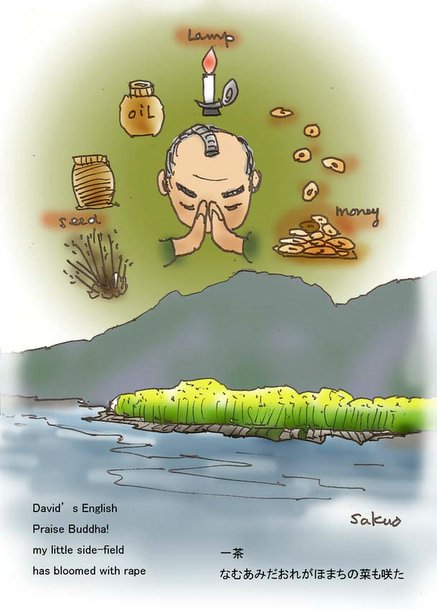
my side-field

David’s English
Praise Buddha!
my little side-field
has bloomed with rape


一茶
なむあみだおれがほまちの菜も咲た
namu amida orega homachi no na mo saita

sakuo Renku
ばれずに実って菜種はお金
barezu ni minotsu te natane ha o-kane

Fruiting without being disclosed,
the rapeseed will be money.
 Posted by Picasa

Saturday, September 30, 2006

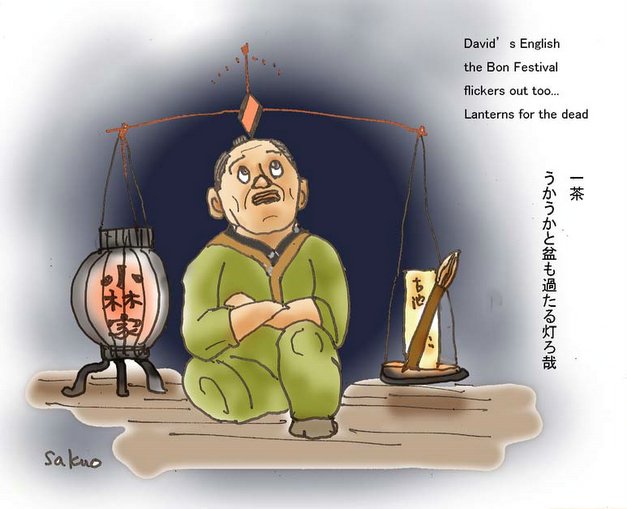
native village or Edo city

1804
一茶
うかうかと盆も過たる灯ろ哉
uka-uka to bon mo sugitaru to^ro^ kana

David’s English
the Bon Festival
flickers out too...
Lanterns for the dead

David’s comment http://cat.xula.edu/issa/
Uka-uka to is an old expression meaning (1) not at peace or (2) thoughtless or absentminded; Kogo dai jiten (Shogakukan 1983) 182. In this case I am assuming that Issa is using the first meaning: the lamplights flicker restlessly as the festival ends. The Bon Festival of the Dead takes place in Eighth Month in the old lunar calendar. At this time, people light lanterns to guide their ancestors' spirits back home.

sakuo Renku
1804 Age 42, lived in Edo. His father died before 3 years.
His works began to get reputation in Edo. But he though that
he have to come back to the native village as the successor.

故郷恋し江戸にも未練
furusato koisi Edo nimo miren

longing for native village
still attached to Edo
 Posted by Picasa

Thursday, September 28, 2006

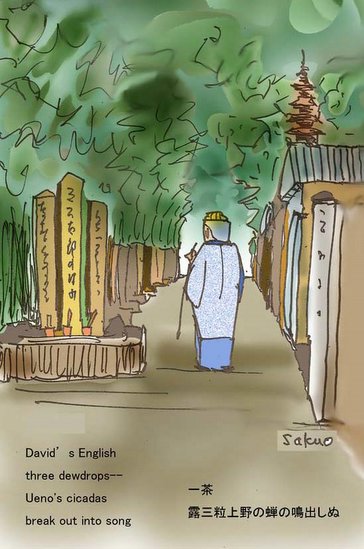
forest of temple

David’s English
three dewdrops--
Ueno's cicadas
break out into song

Issa, 1812

一茶
露三粒上野の蝉の鳴出しぬ
tsuyu mi tsubu ueno no semi no nakidashinu

sakuo Renku
成仏願い寺の森行く
jyou-butu negai tera no mori yuku

pray becoming Buddha
go through the forest of temples


visit http://cat.xula.edu/issa/ Posted by Picasa

Wednesday, September 27, 2006

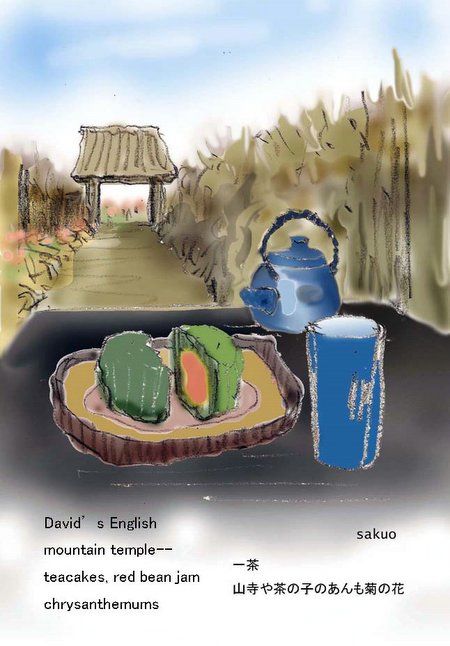
a souvenir for family

1818
一茶
山寺や茶の子のあんも菊の花
yamadera ya cha no ko no an mo kiku no hana

David’s English
mountain temple--
teacakes, red bean jam
chrysanthemums

sakuo Renku
餡の茶菓子や家族の土産
an no tyagasi ya kazoku no miyage

jam teacakes—
a souvenir for family
 Posted by Picasa

Monday, September 25, 2006

the love of stars,men and insects

David’s English
katydid--
caught by someone
waiting for the stars

一茶
きりぎりす星待人に取られけり
kirigirisu hoshi matsu hito ni torare keri
by Issa, 1809

sakuo Renku 連句
星人虫の恋の夜
hoshi hito mushi no koi no yoru

of stars, men and insects
the night of love

David’s comment
The haiku refers to Tanabata, a festival that takes place on the seventh day of Seventh Month. According to a romantic legend, two celestial lovers--the stars Altair and Vega--are separated by Heaven's River (the Milky Way). One night a year (Tanabata night), they cross the starry river to be together. A katydid (kirigirisu) is a green or light brown insect, a cousin of crickets and grasshoppers.

visit http://cat.xula.edu/issa/ Posted by Picasa

Sunday, September 24, 2006

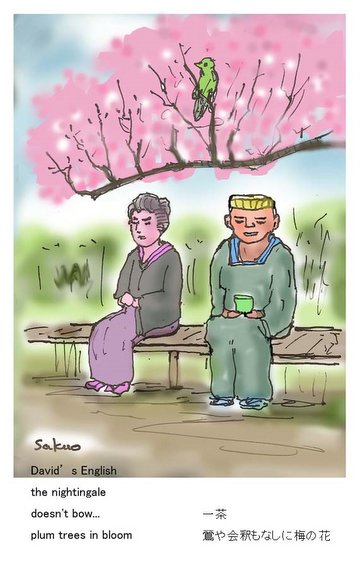
sit down beside

David’s English
the nightingale
doesn't bow...
plum trees in bloom

uguisu ya eshaku mo nashi ni ume no hana
一茶
鶯や会釈もなしに梅の花
by Issa, 1814

sakuo Renku
横へ座ってお茶を一杯
yoko he suwatsu te otya wo itsupai

sit down beside
have a cup of tea


David's comment.
The courtly nightingale seems to take the plum blossoms for granted, not bowing to them--unlike, one presumes, Issa. Issa uses two spring season words in the poem: nightingale and plum blossoms, a popular combination in Japanese art.

visit http://cat.xula.edu/issa/ Posted by Picasa

Friday, September 22, 2006

the speech of the go-between


David’s English
"Good luck's coming!"
the peony longs
to be heard

fuku kuru to kiite hosigaru botan kana
一茶
福来ると聞てほしがるぼたん哉

by Issa, 1824

Shinji Ogawa points out that the phrase, kiite hoshigaru means "longing to be listened [to]." He comments, "The peony is so beautiful that it seems to say in a loud voice, 'Good luck is coming.'"
http://cat.xula.edu/issa/

sakuo comment
Peony is the kigo of fifth month. In 1824 May Issa married with third wife.
He was 62 years old with loneliness of single.
After three months they divorced.

sakuo's Renku
仲人口につい乗せられて
nakoudo-guti ni tui nose rare te

the good speech of the go-between
unintentionally followed
 Posted by Picasa

Thursday, September 21, 2006

go around for waking up


David’s English
wake up! wake up! my children--
swallows, pigeons
sparrows

oki yo oki yo ako ga tsubame hato suzume
一茶
起よ起よあこが乙鳥鳩すずめ

by Issa, 1814

sakuo 連句
朝だ朝だと起こして廻る
asa da asa da to okoshi te mawaru

morning has come
go around for waking up

Wednesday, September 20, 2006

dog pray for the flowers

David’s English
cherry blossoms scatter--
growling Buddha's name
a temple dog

hana chiru ya sho^myo^ unaru tera no inu
一茶
花ちるや称名うなる寺の犬

by Issa, 1810

sakuo 連句
南無阿弥陀仏と花を供らう
nami ami dabutsu to hana wo tomonau

namu-ami dabutsu
dog prays for the flowers

my heart like as water

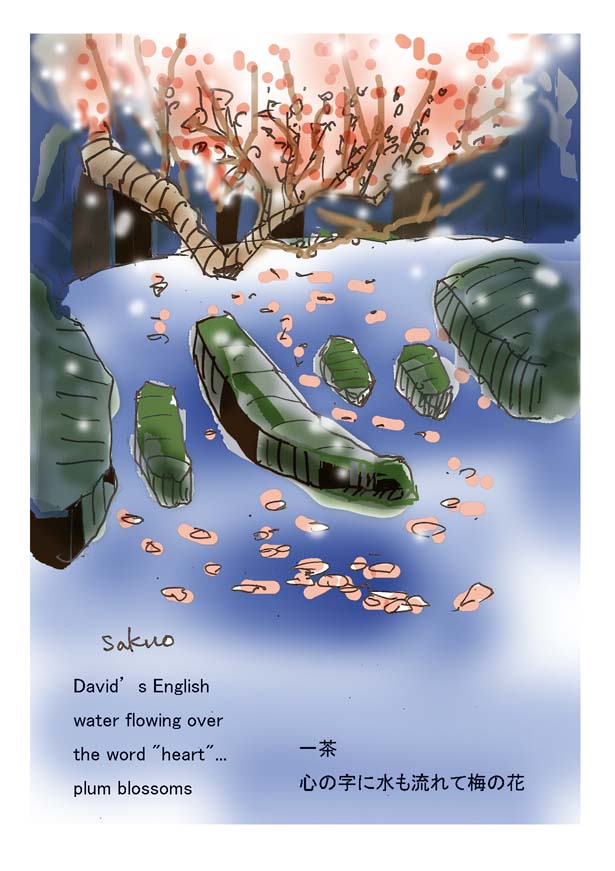
David’s English
water flowing over
the word "heart"...
plum blossoms

shin no ji ni mizu mo nagarete ume no hana
一茶
心の字に水も流れて梅の花

1827 age 65, he died on December of this year.
Last year he married with third wife.

sakuo Renku
心も水もわだかまり無し
kokoro mo mizu mo wadakamari nasi

my heart like as water
flowing freely.

Monday, September 18, 2006

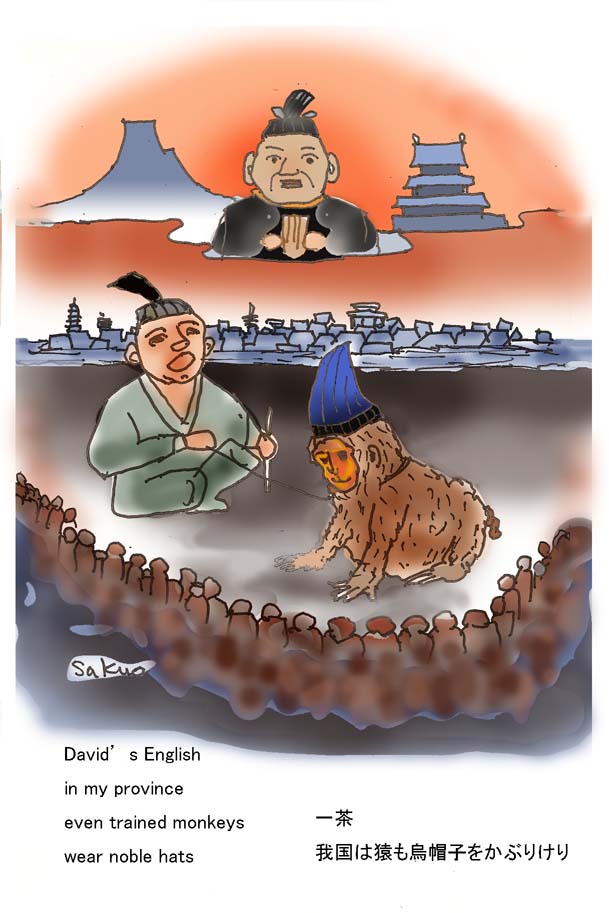
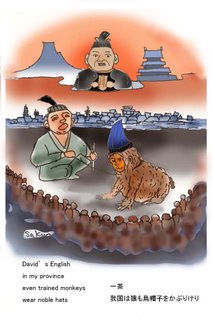
Edo castle at the back

David’s English
in my province
even trained monkeys
wear noble hats

waga kuni wa saru mo eboshi wo kaburi keri

一茶
我国は猿も烏帽子をかぶりけり

by Issa, 1816

David's comment
A jab at local politicians? Literally, Issa says that the monkey is wearing the courtly headgear of a nobleman. Dancing monkeys perform their tricks in the New Year's season.

sakuo’s comment
The founder of Edo government is Ieyasu.
When he come into Edo castle firstly, his horse got injured at the leg.
A monkey dancing team prayed for the horse. After saving the horse ,
the monkey team got high confidence from the founder and got special
permition that was free entrance to the castle at three times a year .
They were given money as rewards every year.
In Edo era, there were many monkey dance teams in Edo city.

sakuo Renku
edo-jyou wo seni saru ibaru kana

Edo castle at the back
were monkeys arrogant

visit http://cat.xula.edu/issa/
Saturday, September 16, 2006

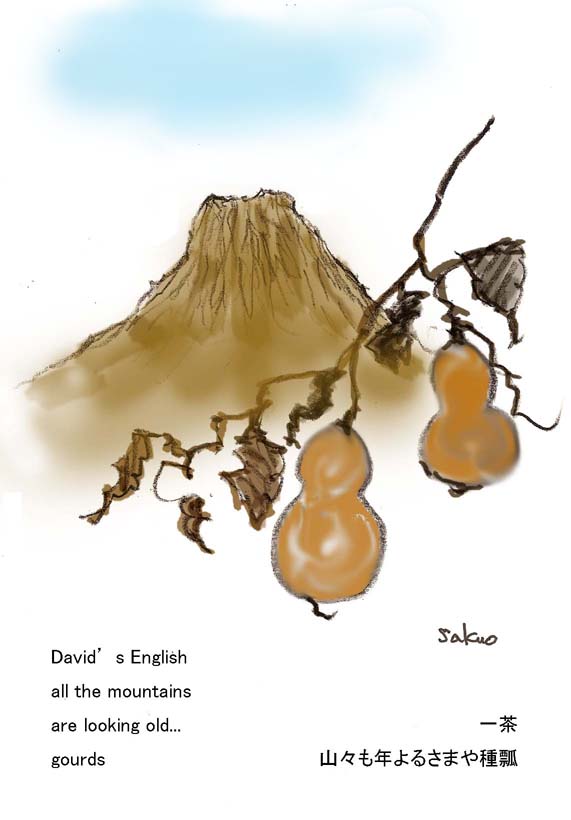
the time of harvest

1805 age 43, his father died before 4 years.

一茶
山々も年よるさまや種瓢
yama-yama mo toshiyoru-sama ya tane fukube

David’s English
all the mountains
are looking old...
gourds

D’s comment
Or, more literally, "seed gourds" (tane fukube). Though the kanji for "gourd" is today read as hisago, Issa read it as fukube.

sakuo Renku
jinsei mo aki syukaku no toki
人生も秋収穫の刻

life approaching to Autumn
now the time of harvest


visit http://cat.xula.edu/issa/

Friday, September 15, 2006

from one founder


一茶
君が世や主なし塚もかざり松
kimi ga yo ya nushi nashi tsuka mo kazari matsu

by Issa, 1818

David’s English
Great Japan!
even an ownerless grave
decorated with pine

His comment
"Great Japan" is my translation of kimi ga yo, a phrase that refers to the emperor's reign and begins the Japanese national anthem. Someone has placed a New Year's pine-and-bamboo decoration on the grave.

sakuo comment and Renku
kimi means emperor, and yo is reign.
Issa admitted that Japan is owned by Emperor.
Ownerless mound is an ancient grave that would belong to followers of
old emperors.
Mostly Japanese think that we have come from same ancestors that were all emperor’s families.
At Issa’s age, nationality has been elevated by approaching of foreign ships.


我等始まる一元の始祖
ware ra hajimaru itigen no shiso

we have started
from one founder

Thursday, September 14, 2006

without freedom


David’s English
does the caged
nightingale hear?
mountain cuckoo

一茶
鶯は籠で聞かよ閑古鳥
uguisu wa kago de kiku ka yo kankodori

1822 Age 60,

sakuo Renku
自由なき身は上手く歌えぬ
jiyu naki mi ha umaku utae nu

without freedom
does not sing well

Tuesday, September 12, 2006

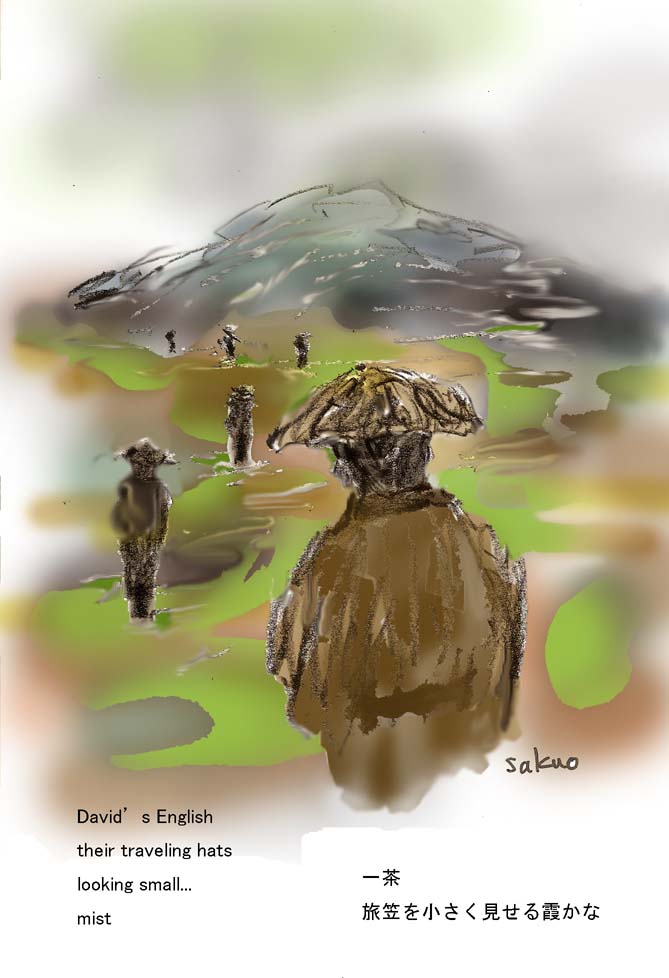
traveling hats in mist


David’s English
their traveling hats
looking small...
mist

一茶
旅笠を小さく見せる霞かな
tabi-gasa wo chiisaku miseru kasumi kana

1796 , age 34. journey on West District,

David's comment
The hat is an umbrella-hat.

Sunday, September 10, 2006

poor Haiku-isst


David’s English
in plum blossoms
kettle soot won't come off...
my wrinkled hands

his comment
Is Issa "ashamed" of his dirty hands amid the pure blossoms?


一茶
梅さくに鍋ずみとれぬ皴手哉
ume saku ni nabe-zumi torenu shiwade kana

sakuo 寸評

1804 age at 42, Leaving from the old sect, he had jointed to new
Seibi's party who was Issa's sponcer as well as great haiku-ist.

http://cat.xula.edu/issa/